Thursday, May 7, 2015
Compost City: Practical Composting Know-How for Small-Space Living By Rebecca Louie
Absolutely EVERYTHING you wanted to know about composting, especially for limited space! I’ve been an organic gardening and a composter for decades and this book still had so much to offer. Author Rebecca Louie uses a whimsical, sometimes rollicking style of writing to give the most thorough guide to all types of composting that I have ever seen. Her playful guide includes details about both passive and active composting; everything from small containers to the tried and true 3-bin method. Best of all every section contains a troubleshooting section so the composter can figure out what needs fixing or what went wrong with their compost. She covers worms, literally! The book includes a wonderfully detailed guide to vermiculture including how to build and maintain your worm bins, of course the care and feeding, and even warnings on how to keep your worms happily contained so they don’t go astray!
Compost City even discusses in depth bokashi composting which makes it possible to compost the things they always tell you not to compost like greasy foods, meats, fats, and other undesirable elements. A marvelous side product of bokashi gives you an incredible drain cleaner too.
Ever wondered what to do with pet waste? The author has a section on that too. Many gardeners may have stacks of Rodale Press gardening books on their shelf; I know I do. But kudos to Roost Books for believing in this project and publishing a book that details just about every possible procedure and question you might have about all kinds of composting. The last portion of the book even gives tips on activism and starting your own composting venture at your local community, school, church, or vacant lot. The book is full of case studies of successful projects from all over and useful knowledge from experienced composters.
For anyone who gardens on a small or large scale this book is a must have. It answers questions many gardeners won’t even have thought of yet! It doesn’t matter if you are growing food for the community or your family, or even if your garden is nothing but potted plants on a balcony or patio, this book has methods you can use to live more sustainably. Stop throwing food scraps in the trash and learn how to turn them into rich black gold to make even the tiniest garden a better place!
Watch for this coming up from Roost Books on May 19, 2015 at your favorite booksellers!


Thursday, February 19, 2015
Orion Magazine | Dreaming in Dirt by BK Loren
Orion Magazine | Dreaming in Dirt by BK Loren
A beautiful piece reminding us that our imprint on the earth remains forever.
A beautiful piece reminding us that our imprint on the earth remains forever.
Tuesday, February 3, 2015
Man in the Maze
Monday, January 27, 2014
Climate Change in 19 haiku
Take a look at this article on Greg Johnson's effort to distill a massive report from the Intergovernmental Panel on Climate Change (IPCC) into 19 illustrated haiku. Says it all!
http://daily.sightline.org/2013/12/16/the-entire-ipcc-report-in-19-illustrated-haiku/
Sunday, December 15, 2013
Tiny scrubber beads in cosmetics are coming back up the food chain to us!
So read the ingredients on the cosmetics and health products you buy. If it uses plastic beads, don't buy it. There are plenty of alternatives out there as companies such as Burt's Bees, Tom's, St. Ives, Weleda and others well know and use. Support the companies who are doing the responsible thing!
http://www.nytimes.com/2013/12/15/us/scientists-turn-their-gaze-toward-tiny-threats-to-great-lakes.html?nl=todaysheadlines&emc=edit_th_20131215
Sunday, November 24, 2013
Get rid of your lawn and grow native plants and trees. Save the monarchs and the bees!
Monday, April 8, 2013
ASARCO towers coming down this weekend.
After years of controversy, the towers of Asarco will be demolished this weekend. Much earlier in this blog I had posted about the Asarco controversy. This isn't really the end. Although the towers re coming down, no one seems to quite know what to do about prime real estate that is saturated with heavy metals and is unarguably an integral part of the history of El Paso and the University of Texas at El Paso.
Monday, October 8, 2012
Is today a good day to die?
Is today a good day to die?
Upon the passing of
Fanny the Wonder Dog 1999-2012
 I seem to count the stages of my life by the dogs I have loved; more importantly, the dogs who have loved me. We inherited Fanny when acquaintances of ours moved overseas and could not take the dog. I had just had to put down Brandy, my beloved golden retriever who had developed osteosarcoma, a dreadful way to go. The cancer was in her skull and her head bones grew and grew until the pressure upon her eyes caused her to go blind. When she walked into the pond and nearly drowned, we knew it was time. Brandy had helped me raise my son and his friends. She was the ultimate pet, perfectly content and long-suffering no matter how many times her ears or tail were pulled by small children. She was two years old when I got her; my son was eighteen months and they grew up together.
With Fanny I wasn’t really ready for another dog, but there she was; an older dog unlikely to find a home quickly. So we agreed to take her. Fanny was the most remarkably potty-trained dog I have ever known. She never once went anywhere but her own yard. For weeks we carried around little plastic baggies that were never used on walks. Even on trips to the park, or long walks, Fanny held it until she got home.
She was big and blonde and not the brightest of dogs. But from the first day, she decided she was my dog. Don’t know why. To tell the truth maybe I resented having her there instead of Brandy. She made her decision and that was that; unquestionably my dog whether I liked it or not. Curious, affectionate and ever helpful, she just wanted to be close to her people.
Being so large and ferocious made her appear to be a marvelous guard dog. She wasn’t. Actually she was nervous and scared of thunder, loud noises, strangers and probably a host of other things. For a while we had a chow mix, my son’s puppy, and invariably Fanny would look to Ming to see whether she should bark or not? Be scared or not? Ming being a third the size of Fanny made these canine conversations most interesting to observe.
So being a big dog often means hip dysplasia. Gradually the last couple of years, Fanny developed what we call turn-out in ballet. Her hind feet no longer lined up with her front feet; instead they canted outward giving her a rolling sailor’s walk. She still loved walking, chasing any birds foolish enough to stay in range, and carrots. She learned to love carrots when we began juicing again. She would hear the juicer and know that treats were coming. Carrots were a better “carrot” for the dog than any doggy treat ever manufactured.
Walks became more problematic and much shorter. Some days she could do her usual circuit but more often she would visibly tire and ask to go back home. Still the jangle of the leash always perked her up. Our walks became gentle strolls around the block. On a couple of occasions she became so exhausted that she just sat down where she stopped. One time that was on the edge of a curb. And one time it was smack in the middle of the street. What could I do? I sat down with her and was thankful we live in a sleepy neighborhood without many fast cars, or cars at all that evening!
This weekend she couldn’t get up at all. She was still eager to see us, still eager to greet us and still thrilled to have a carrot, but she couldn’t get up. She no longer had control over her hindquarters. For the first time since her hips began giving her problems she clearly was in pain now. The ultimate humiliation for the ultimately house-trained dog was the distress of soiling herself since she couldn’t rise.
Her veterinarian Dr. Janie made a house call this afternoon. My husband asked do we get better medical care as a dog than a human? But I told him only when it’s most likely the final doctor visit. Sometimes I think I would want someone to do the same for me. What happens when we reach the end of our days? I want to believe I will still have my joie de vivre but will I when I am incontinent, incoherent, hooked to machines and know that it won’t ever get any better? Dr. Janie says maybe it would be a good thing for humans too but she fears people would abuse it. I don’t know. Today it looks like a gift.
We have a new granddaughter who delighted in visiting Fanny. I’m convinced that her first word was “ruff, ruff.” Later her parents confirmed that her first consistent word was gou-gou which is doggie in Chinese. Come to think of it my son’s first words/sounds were ruff, ruff too Children speak dog more fluently than adults. How do you explain to a not yet two-year old that the gou-gou is gone?
Pink ribbons, pink slips, pink liquid in a needle. Why do some people think pink is a cheery color? The vet tech holds Fanny’s body and I hold her head while Dr. Janie slips the needle into Fanny’s front leg. I continue to stroke her head as her eyes begin to close. Her heartbeat calms. Her breathing slows. And slows. And stops.
Today is a gorgeous autumn day. The sun is warm but not too hot. A gentle breeze ruffles our hair. Today is good. Dr. Janie takes out her stethoscope and listens for the giant heart that has stilled. Fanny was a good dog. She had a good life. No one should have to suffer pain needlessly. Today was a good day to die. Rest in peace.

Monday, July 23, 2012
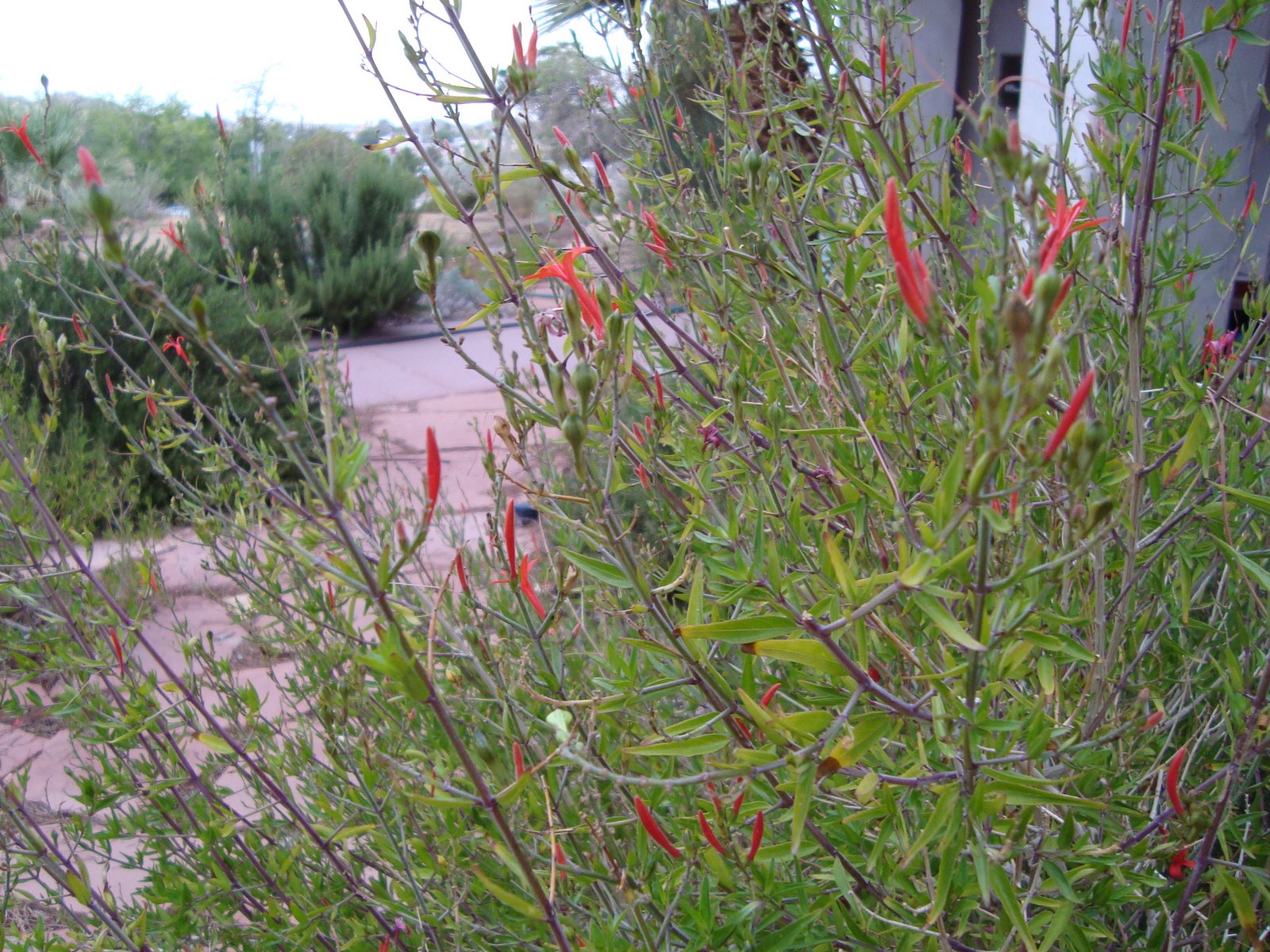
Front Yard Garden 7-23-2012

In honor of my friend Liz who wants to know more about xeriscaping and native plants, I thought I would share the glory of my front yard after the most welcome rain shower this afternoon. Who says the desert is all cactusy? Here
 are rain sages, salvia, agistache, desert marigold and red yucca just to show the colors of the Chihuahua Desert.



Friday, May 4, 2012
TEDxUofL 2012 Justin Mog -- Sustainability is fun AND easy!
This TED talk was great promoting sustainability in an urban area where I lived for a number of years. Yea, Old Louisville and University of Louisville for promoting light living on the planet. We should ALL be hanging our clothes to dry, walking/biking, composting and reusing and conserving our precious water!
Monday, February 27, 2012
World Order - Machine Civilization
I just discovered this great precision performance group. This video seems to be making more of a social statement and I also enjoyed World Order - Mexico and World Order - New York City.
Friday, April 2, 2010
Spring Garden 2010

Spring arrived in El Paso and the garden beckoned once again. We spent part of our Spring Break week getting everything into the ground. Albert broke up the plot by himself because of my crazy schedule and workload but we both got our hands dirty planting seeds and slips. I'm not at all sure that we saved any money on groceries last summer but I have to say there is something quite satisfying about stepping out the back door and picking your own tomatoes or spinach. No question that we are pesticide and noxious chemical free

We are letting a gorgeous bok choy flower and go to seed, hoping to salvage its seeds to replant. The parsley came back nicely as did some of the other herbs. Sage didn't make it through the winter nor did the basils. El Paso's harsh summer sun coupled with unpredictable winters sometimes just wipes out plants we thought would make it. Gardening in the Southwest is completely different from what I knew as a farm child. We don't bother with planting runner beans to climb up corn, my job when I was little. Corn is dirt cheap here and just not worth the water or the space. This year Albert had the idea to siphon water from the fish pond for a little extra fertilize emulsion. The pond gets fresh water and the garden stays moist. Daily we watch over our eggplant, lettuce, garlic, tomatoes and peppers. The beans and zucchini are just beginning to peek out of the starter pots. Every season becomes a new experiment.
Best of all, the mockingbird returned. The day after we planted everything, he was high in the tree singing every song he knew with such joyous abandon. It almost seemed that he was thrilled to see our garden and us digging and messing around in the yard. Come to think of it, having the garden probably does supply a few more bugs, grubs, worms and such for his family's snacks so maybe his joy was sincere. I stood in the backyard watching and listening and finally chirping back at him just to have something to contribute to the conversation.

Fannie the Wonder Dog does not understand our fascination with playing in the dirt but she happily keeps us company and enjoys the mockingbird who sings for all of us.
Saturday, September 19, 2009
Saturday, September 12, 2009
Is Your Drinking Water Safe in Your State?
This New York Times article and interactive map show the appalling violations of the Clean Water Act nationwide and the difficulties of enforcing compliance. It is distressing but not surprising to see that in Texas 70% of the facilities have had violations with very little success at enforcing corrections. I hope everyone of you who are reading this will boycott bottled water. Use a home filtration system, even a Brita pitcher, and fill up your own non-plastic bottle. Steel bottles are inexpensive, easy to clean, long-lasting and ultimately recyclable. Plastic bottles only contribute to the problem.
A related article debates how much weed killer is in our drinking water.
http://www.nytimes.com/2009/08/23/us/23water.html?ref=us
A related article debates how much weed killer is in our drinking water.
http://www.nytimes.com/2009/08/23/us/23water.html?ref=us
Wednesday, September 2, 2009
Where the Wild Things Were
Mr. Block's column in the New York Times reminded me of some of the writing we passionately discussed in our Chatham Nature Writing course. I had hoped that Block wouild credit Maurice Sendak for the appropriation of his title of his 46 year old classic Where the Wild Things Are but even so it is a thoughtful coming of age essay. Wasn't there a time in most of our childhoods when we dreamed of taming, befriending a wild creature?
Is Blasting a Mountain Away an Honor?
I have mixed feelings about this monument just as this columnist does. There is so much that could be done to honor great Native Americans but I just don't think this is the best way. When at the same time all over the country, no, actually all over the world, indigenous people are fighting to protect sacred places and environmentalists are trying to protect wild and natural places; how can anyone justify blowing up a mountain? And people applauded? For what?
Tuesday, July 28, 2009
Seven things you thought you could recycle
My classmate Becca just posted this great article on her blog http://backyardtransliteration.blogspot.com/
Great information and worth sharing here.
Great information and worth sharing here.
Wednesday, July 8, 2009
Sunday, April 12, 2009
A Sense of Wonder – A reflection on nature writing
This semester of nature writing has expanded my perceptions of nature writing just as last semester’s course on travel writing greatly expanded my views on writing about place. More than ever I think that both are connected. When I travel, I am drawn to natural locations so it is difficult to disentangle writing about place and writing about nature. My personal library has grown too. I have writers on my shelf now that weren’t there before. I have been especially intrigued by Native American writers such as Silko but other writers such as Terry Tempest Williams have touched my life. It was vindicating to read works by writers I knew personally, whose works were already part of my vernacular. Re-reading these authors and discovering new works by them was sort of a validation of what I already believed. This is the last formal Chatham Nature Writing entry on this nature blog. Will the blog continue? Most definitely. It has become a forum for me to express my personal point of view and to share with others.
One thing that has been on my mind is the reason I chose Chatham. I had researched several schools but when I found Chatham and learned of the connection with Rachel Carson and their focus on the environment and nature, it had to be Chatham for me. Rachel Carson’s Silent Spring had a huge impact on me while I was in high school. Last week at my favorite used book store I came across her book A Sense of Wonder which was written for her nephew but time ran out for her before she finished it. She wrote it in 1956 and it was published by Charles Pratt in 1965. In it she says, “No child should grow up unaware of the dawn chorus of the birds in spring.”
Carson also says, “If I had influence with the good fairy who is supposed to preside over the christening of children I should ask that her gift to each child in the world be a sense of wonder so indestructible that it would last throughout life, as an unfailing antidote against boredom and disenchantments of later years, the sterile preoccupation with things that are artificial, the alienation from the sources of our strength.“
I am thankful to the good fairies that I was born with that sense of wonder. I have tried to impart the same wonder to my son. I hope that my sense of wonder lasts me all the rest of my days.
Subscribe to:
Posts (Atom)


